2012/06/27

Tottori! And Another Mountain


I swear, all I do in Japan is tackle kids during 'english' class, and climb rocks.

This past weekend, some friends and I took a trip to Tottori-ken, famous for having the largest of the three major sand dunes in Japan (the rival dunes are in Aomori-ken and... somewhere else). Tottori also grows nashi (pears) fishes a lot of squid. The squid in Tottori is famous for being fatty and scrumptious, not at all like the chewy and tough tentacles you find in other parts of Japan.

In Kurayoshi, a small, silent town off the beaten path and to the southeast of Tottori City, there is yet another unique reason to visit this least populated of all the Japanese prefectures.


I'll be honest. I forgot the name of this place and as I am at the office, and can't read enough Japanese to figure it out with the web, I will probably not be including said vital information in this post. But it's famous in a quiet way. Very few of my Japanese friends knew about this place, and none of them had been here. In fact, while we climbed the 700 meters up (doesn't sound like much, does it? keep reading. you'll see.) we were the only foreigners invading the very thin trickle of Japanese tourists. Once we got gaijin photobombed - when Japanese people pretend to take pictures of their friends, but aim the camera at you, instead- and more than once, tourists cheerfully and blatantly took our pictures. How does that conversation go at home? 'Dude! Saw a whitey today!' 'EEEEEEEHHHHHH? Nani? Gaijin? Hountooooooo?' Probably a lot like that.

This dude greets hikers/climbers and laughs at their light-headed optimism. 

This is the 'ground floor' where you enter the temple grounds. You pay a fee to get in
here and then after this you pay another fee to go up the mountain. 

Amazingly tall trees

So you start where the big red arrow is. That is pointing at the picture with all the statues
(go back two photos). Then you start winding your way up the mountain. It's not all
that far, but the fact that you are basically climbing straight up makes it feel like it is
much further!

You climb up this almost right away. It's the
first staircase you encounter after all those
stone steps you schlepped up earlier.

There is really only room on the path to go in single file.
Once you hit the entryway to the mountain path, you have some decisions to make. For instance, if you wear shoes without tracking on the bottom, you have to buy straw sandals. They will not let you on the path unless your shoes grip the path otherwise you will fall off the path and die, or at the very least be painfully embarrassed. And of course, if too many people fall off the path, they might have to close it. 

In the above picture, you can kind of see that the people are wearing little white sashes across their shoulders. You may notice there are supposed to be no side bads, and there are supposed to be no long shirts. The path is tricky and you definitely need both hands and both feet free and aware so you can get your monkey on. 

We didn't climb this, it's just interesting.

Lots and lots of green!


This is the beginning of one of the buildings we came across. To get up to this one, we had to hold onto a chain and walk up a rock.. Straight up, almost. 

A view from the corner of that building. 

It's like throwing coins in a fountain, except you have to be careful
that the coins don't fall off and kill someone. 


 More on this later, i have to get ready for lunch!

2012/06/08

Takamatsu and the Ekaiwa


When you think of Japan, if you don't first think of mob members beaten foreigners in back alleys, automated dog washing machines, or Godzilla being badly dubbed, you might think zen. Maybe the wise and calm sayings of that karate instructor in that movie (series of movies, I suppose) come to mind or your inner peace begins to crave the solace of a sculptured garden enclosed behind a Buddhist monastery’s austere stone walls. But day to day life is, of course, very different, and the Japanese seem very incapable of achieving the rest and peace they worship in their art and cultural traditions.

I first thought this when a nationally-touring art exhibit came to Tano. The minutely detailed ink drawings were usually scenes of exquisite peace and quiet; they were moments of stillness in a harbor before fishermen went out for the day, or the unbroken mists draped around cedar forests on a mountainside. Many an old Edo-style building was wrapped up in stony age and time, serene and wise, holding its tradition to itself like a gorgeous kimono, both for decoration and modesty’s sake. But the people who surround me in my town, while lovely, kind and even generous, are not people who sit still well. They aren't likely to sit and ponder a question so much as discuss it volubly amongst each other and ask for a general consensus to solve the problem, then quickly move on to the next trivial pursuit. The individual does not really matter and so cannot find peace, and if the individual can't find it, how can the group which is made up of so many individuals? 

For instance, this beautiful garden was created by a feudal lord for his private relaxation and leisure. The house is positioned with a lovely view of a man-made lake, the sculptured greenery like scenery around it is as though nature had a tasteful manicure in anticipation of a lovely romantic dinner with a long-loved partner. But the majority of the tourists I see walk through the garden move quickly, snapping pictures, chattering to each other, and briskly stepping onward to the next offering. The only people sitting down to enjoy the iris garden were two foreigners. 


I wandered off from the group, because I have a perverse sense of forced independence. I like doing my own thing when and where I want to do it and I don't have much pity on the group as a whole. But they survived of course, because they were the majority. It must have been rough, though, since I am the life and soul of every party.

Similarly, in Shikoku Village, I found the same experience, especially among my own traveling companions. 

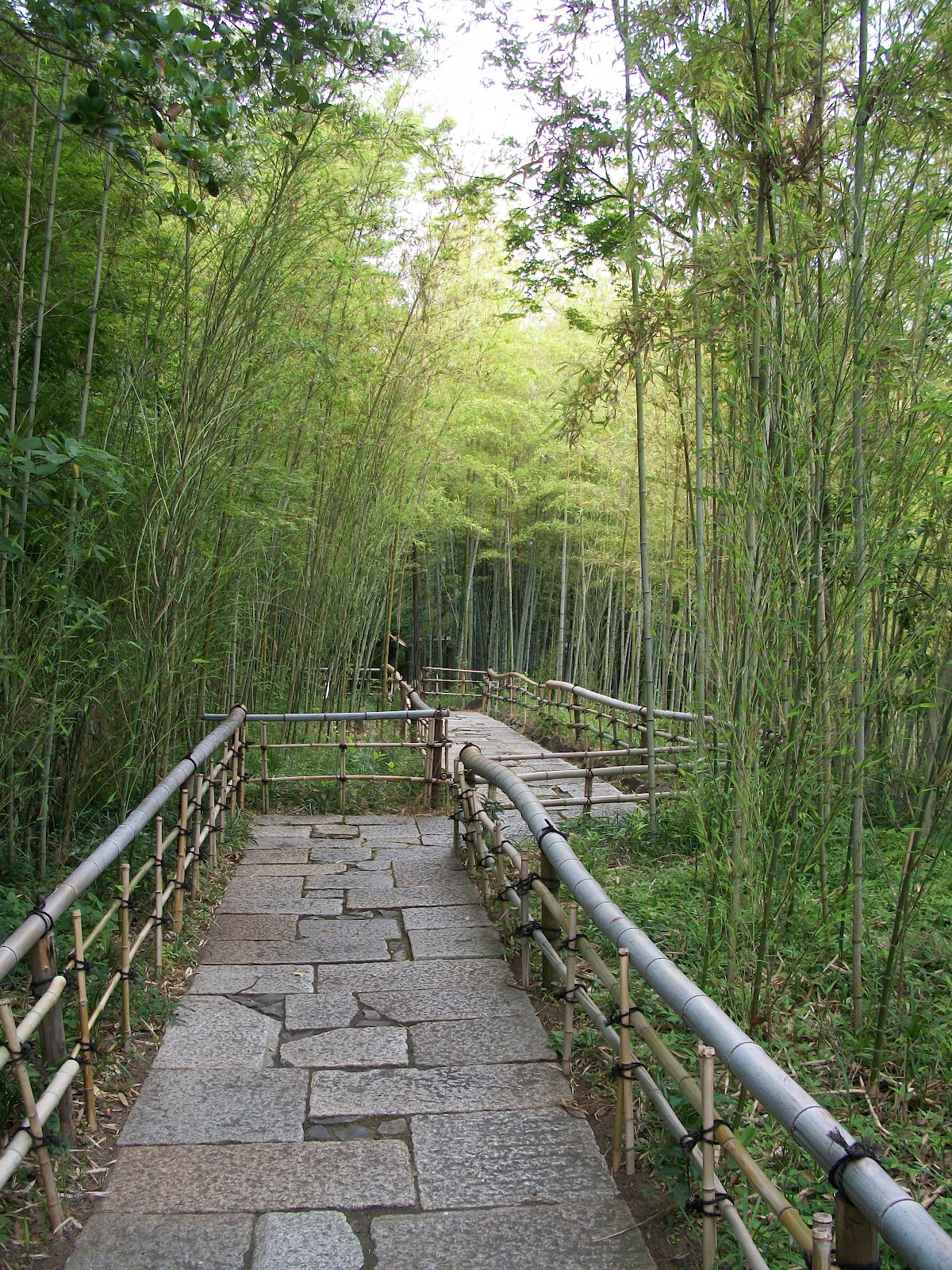
Shikoku Village is a reproduction of what old houses in the mountains of Shikoku were like. The village is carved into the mountain side, a veritable Hobbiton of little round houses connected by sweetly curving paths and marvelously constructed wooden steps. There is a rose garden, a striking bamboo forest, and a multi-tiered waterfall whose overflowing creates a constant and harmonious, reflection-inducing hum. Our group spent about an hour here and promptly moved on to the next place. I spent most of the time wandering alone, listening to the water, staring into the crazy third dimension of bambooed-space, or following my feet down stony and wooded paths. 


Not so my fellow tourists. They walked quickly, talked quickly, enjoyed quickly, and seemed to promptly forget. There was no reminiscent talk later in the trip about the beauties we just saw. There were no conversations about old Japan or sugar-cane processing from the 1600s. It was like a snapshot in an overfull album – glanced at, admired, and quickly forgotten under the onslaught of the next page.